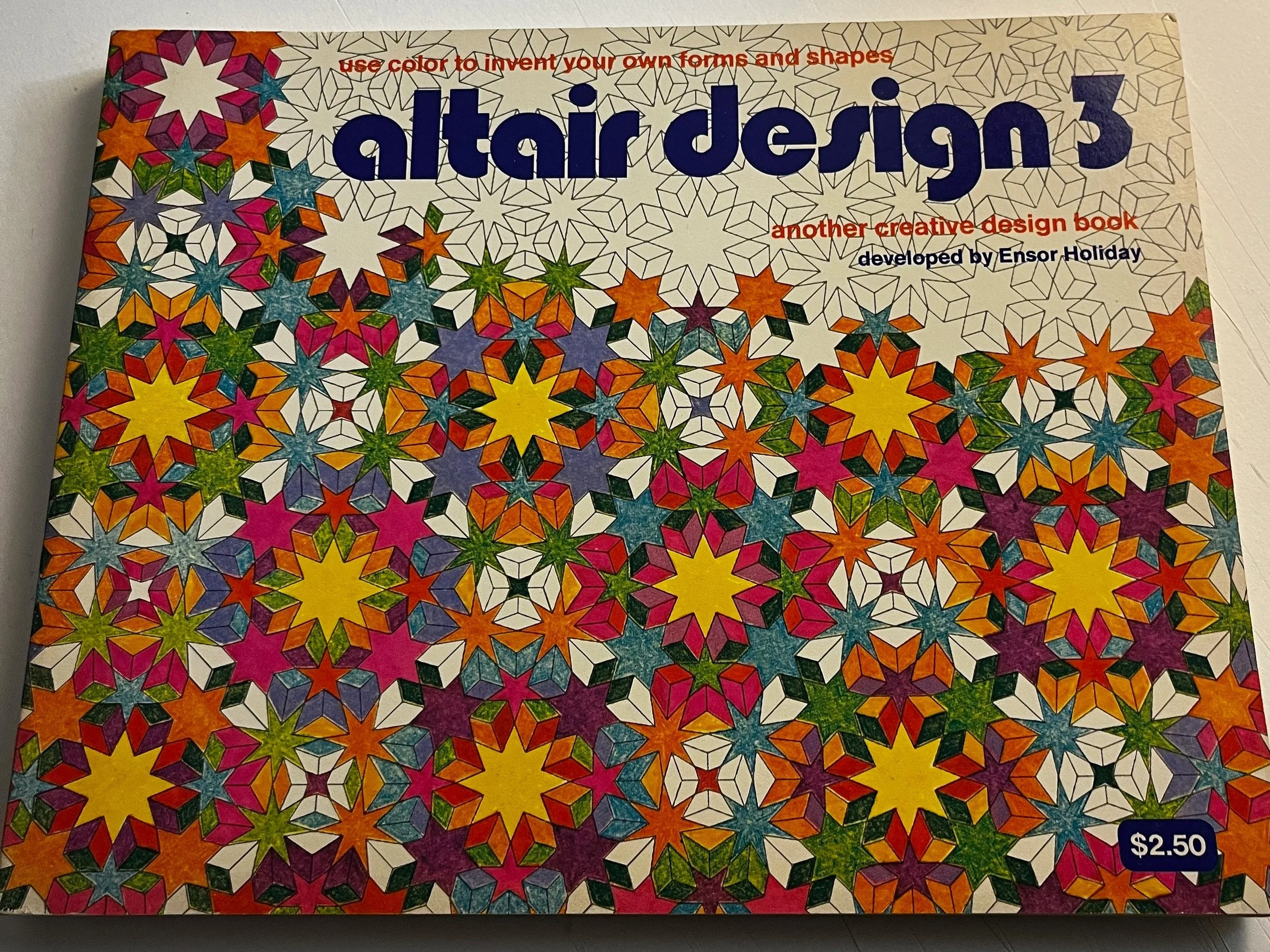
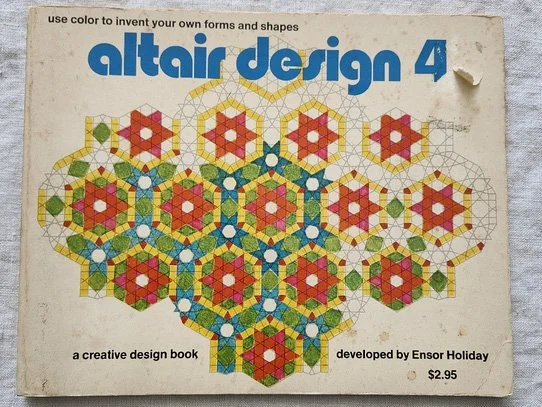
Altair Patterns
As a child of the 1970’s spirograph wheels and Altair books featured prominently in my early design education. Pictorial colouring books were frowned upon, along with pre-printed embroidery kits, and books by Enid Blyton. All these were deemed ‘uncreative’ . Altair paper though, had full approval.
Looking back now, and remembering my love of these papers, I realize what an important part they played in my love of pattern.
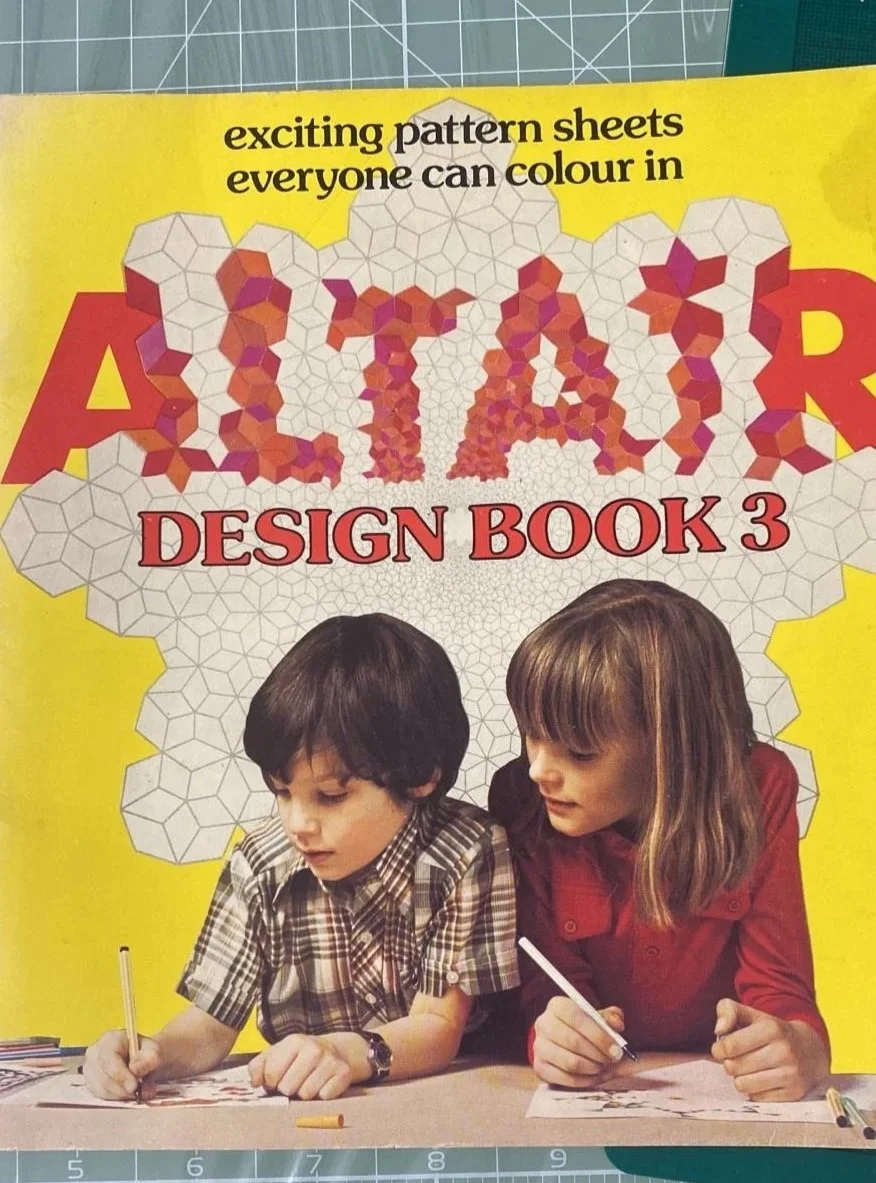
For the uninitiated, Altair papers were faintly printed with the outline of intricate repeated geometric patterns. They could be coloured carefully with infinite possibilities of combinations of colours and shapes. Even working with just two or three colours, the same pattern was transformed by highlighting and picking out different elements – transforming it into undulating diagonal ribbons one time, and star-bursts the next. In thinking about patterns for weave I have frequently found myself doing exactly the same thing – taking a simple geometric pattern and watching how it changes completely depending on the choice of which colours go where.
Here below are some of the uncoloured papers - I am sure they will be familiar to many folks of a certain age.
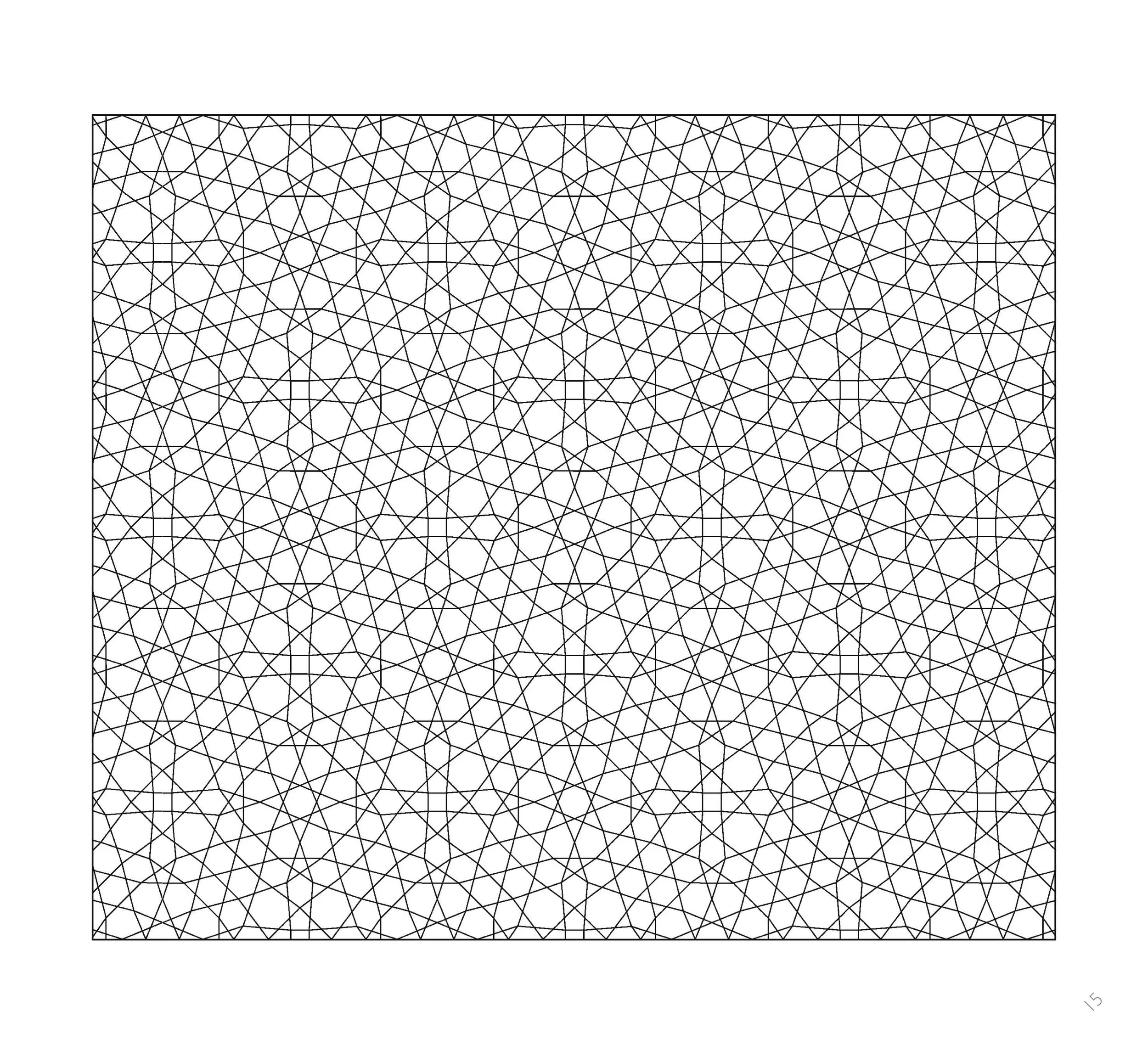
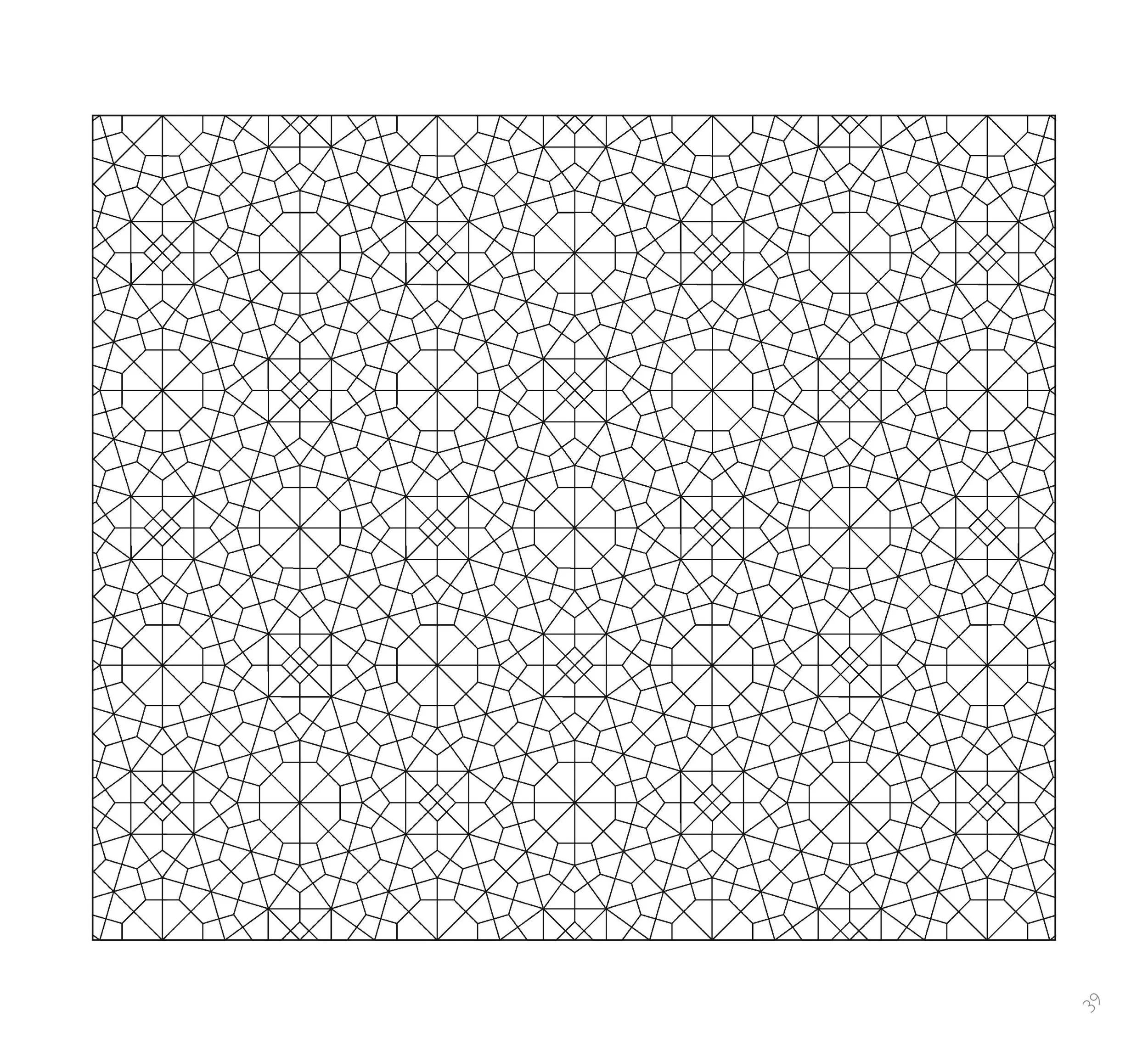
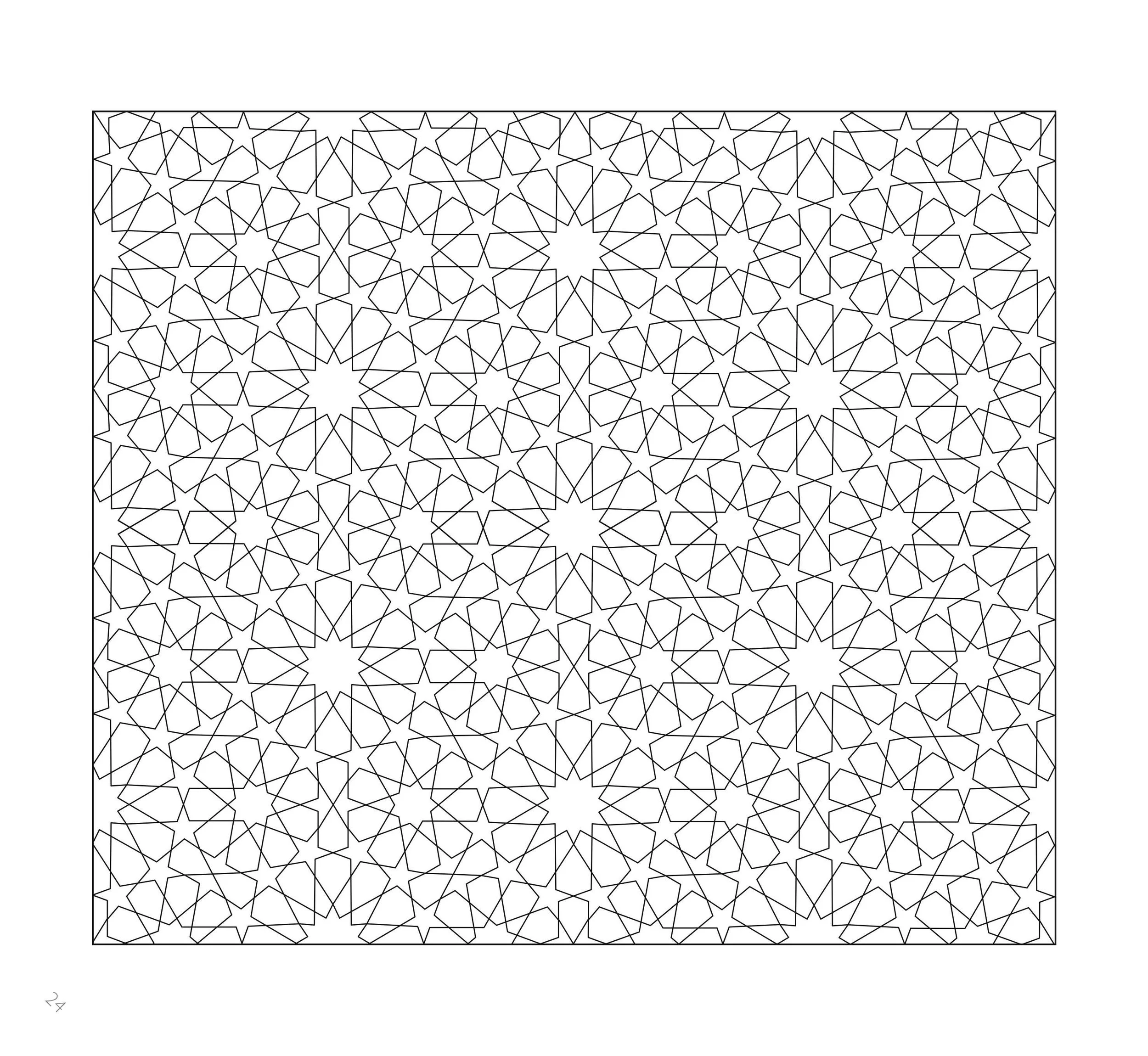
When I am thinking about pattern in relation to weave I have in the back of my mind all the parameters of the loom - the number of shafts, the maximum lifting repeat, the number of weft yarns and so on. Within these set elements the possibilities are infinite. I find it fascinating how, even with very simple patterns and using the same small set of colours, the outcome can vary so much, with shapes seeming to come to the fore in some versions, and to recede into to the background in others.
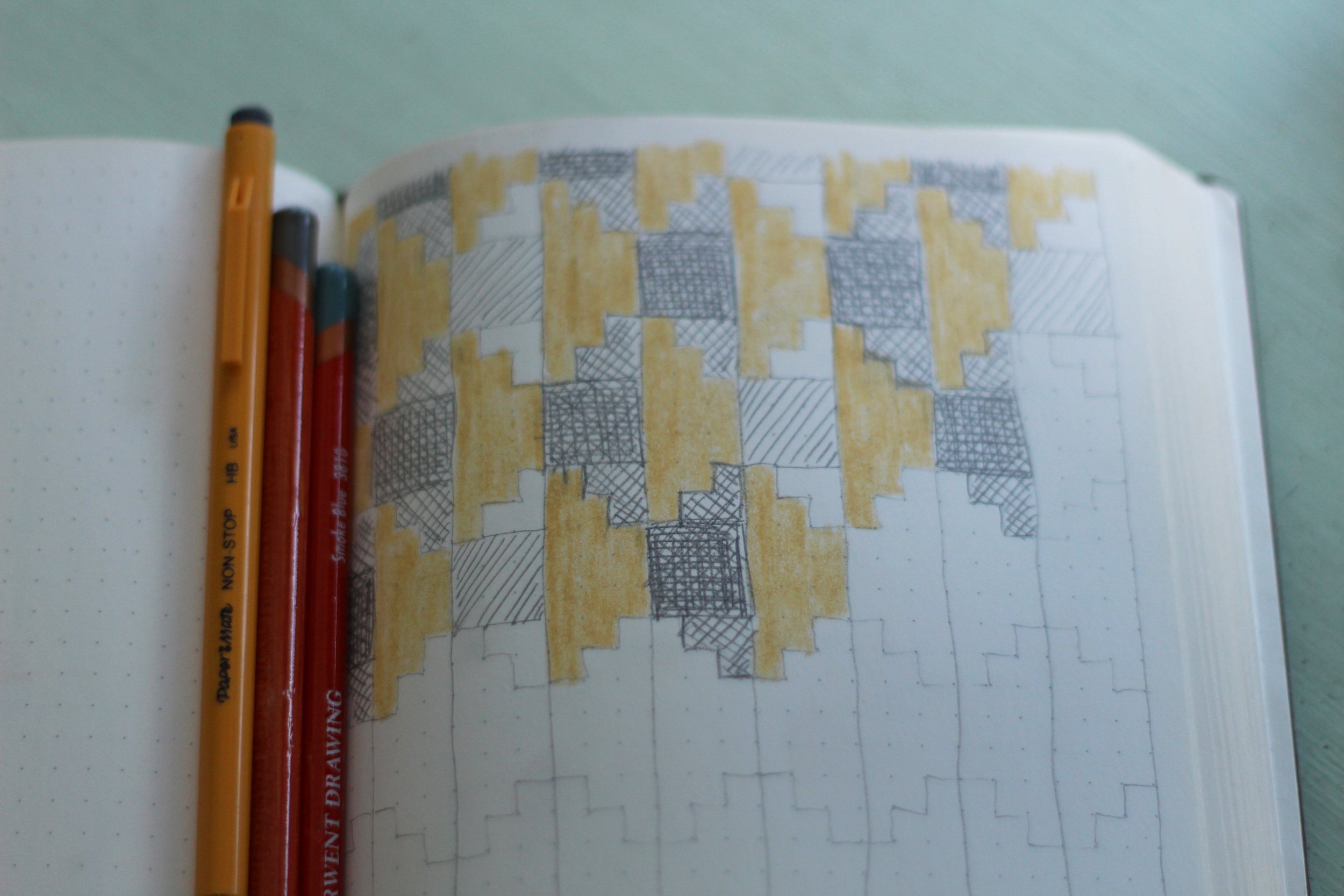
I usually use a dotted paper when I am planning double-cloth weave patterns, drawing first the outline in faint pencil and then exploring colour within the shapes. In my designs I am drawing my own outlines of course, but in many ways it’s uncannily close to what I was doing at seven years old.
I have been reading up a little about the history of Altair patterns. They are the brainchild of mathematicians Ensor Holiday and Roger Burrows and were based on patterns found in Islamic architecture – tiles, lattice windows and so on. Holiday and Burrows met in 1969, and in 1973 the first Altair books were published by Longmans Press. There is a charming account by Roger Burrows about their first meeting on the Wooden Books website – current publisher of the Altair books.
And for real enthusiasts there is a lovely post script to the mystery of one of the very first pattern sources on Roger Burrow’s website here, tracing back one of the first Altair patterns which Holiday originally found illustrated in Jules Burgoinn’s 1879 ‘Les Elements de l’Arabe’ to a latticed window in the mid fourteenth century Madrasa of Sargatmish in Cairo.